Related hub: what the world misses when African research stays invisible.
Discover why Africa has remained underrepresented in research works, the barriers limiting its visibility, and how Afropus helps make African scholarship easier to discover.
TL;DR
- African researchers contribute valuable knowledge across disciplines, yet their work does not always receive the visibility it deserves globally.
- Limited funding, publishing costs, language barriers, and unequal research networks can restrict opportunities for African scholars.
- Gaps in research indexing and digital discoverability can make African journals, researchers, and publications harder to find.
- Improving visibility requires stronger research infrastructure, accessible discovery platforms, institutional support, and international collaboration.
- Afropus helps address the discoverability challenge by making African research, journals, researchers, and scholarly contributions easier to find.
Africa has a wealth of research talent, with scholars contributing to fields such as medicine, agriculture, technology, education, and climate science.
Yet, many African scholarly contributions remain less visible in global academic discussions than they deserve to be.
This underrepresentation is not simply about how much research Africa produces. Funding constraints, publishing barriers, limited indexing opportunities, and gaps in digital discoverability can influence whether research reaches the people who need it. Valuable findings may exist without being easy for other researchers, institutions, or readers to find.
Improving visibility requires addressing these barriers and making African scholarship more accessible. Afropus, a research indexing and discovery platform focused on African scholarship, contributes to this effort by helping people discover African journals, researchers, institutions, and research.
Understanding the causes of underrepresentation is an important step towards making African contributions more visible.
Table of Contents
What Does It Mean for Africa to Be Underrepresented in Research Works?
African research underrepresentation refers to the limited presence, visibility, or recognition of African scholarly contributions within parts of the global research ecosystem.
It can involve publication opportunities, representation in research indexes, international collaboration, and the discoverability of academic work.
Understanding the issue requires distinguishing between the research being produced and the extent to which people can find, access, and engage with it.
Why Visibility Matters for African Scholarship
Research visibility helps connect scholarly work with the people who can learn from it, build on it, or apply its findings.
When African research is easier to discover, it has greater opportunities to contribute to academic discussions beyond its immediate institutional or geographic context.
Better discoverability can support:
- Academic collaboration: Researchers can identify colleagues and studies relevant to their work.
- Knowledge sharing: Students, academics, and practitioners can find research addressing relevant questions and challenges.
- Institutional recognition: Universities and research organisations can make their scholarly contributions more accessible.
- Research development: Scholars can locate existing findings, identify knowledge gaps, and build on previous studies.
Platforms such as Afropus contribute to this process by helping readers discover African scholarship in a more accessible environment.
Greater visibility does not guarantee citations or recognition, but it creates more opportunities for research to reach relevant audiences.
Why Africa Has Remained Underrepresented in Research Works
Several interconnected factors contribute to the underrepresentation of African scholarship in global research.
Financial constraints, publishing barriers, limited indexing opportunities, and poor digital discoverability can all affect how easily African research reaches wider audiences.
Limited Research Funding and Infrastructure
Research requires sustained investment in equipment, laboratories, academic resources, and skilled personnel. Limited funding can make it difficult for some African institutions to conduct large-scale studies, maintain facilities, and support long-term projects.
Funding constraints can also affect researchers’ ability to publish and share their findings.
Key challenges include:
- Limited access to research facilities and specialised equipment.
- Insufficient funding for long-term studies and academic projects.
- Inadequate institutional support for publishing and research dissemination.
High Academic Publishing Costs
Academic publishing can involve article processing charges, editing, translation, and other expenses. These costs can create barriers for researchers who lack institutional funding or access to grants.
Financial constraints may affect where researchers publish and how widely their findings circulate. Although some journals offer free or subsidised publishing options, accessing suitable publication opportunities can remain challenging.
Limited Representation in Major Research Indexes
Research indexes help readers discover academic journals, articles, authors, and institutions. When African journals are not represented in widely used indexes, their publications may be harder to find through those research systems.
Factors that can affect journal inclusion include:
- Meeting specific indexing criteria and technical requirements.
- Maintaining consistent publishing schedules and editorial standards.
- Having the resources to manage metadata and digital publishing infrastructure.
Accessible discovery platforms can help address some of these visibility gaps.
Afropus contributes to this effort by providing a dedicated environment for discovering African journals, researchers, institutions, and scholarly contributions.
Language Barriers and Unequal Publishing Opportunities
Language can influence how easily research reaches international audiences. Researchers publishing in French, Portuguese, Arabic, and African languages may encounter additional barriers when their intended readers primarily use English-language academic resources.
Challenges include:
- Translation and academic editing costs.
- Limited access to multilingual publishing and discovery resources.
- Difficulty reaching audiences unfamiliar with the language of publication.
Making research easier to discover across languages and regions can help more readers identify relevant scholarship.
Unequal Access to Global Research Networks
Academic networks influence collaboration, funding opportunities, mentorship, and publishing prospects. Researchers with established international connections may have more opportunities to share their work and develop partnerships.
Researchers with fewer connections may face challenges such as:
- Limited access to international conferences and academic events.
- Fewer opportunities for mentorship and institutional partnerships.
- Difficulty identifying researchers working on related topics.
Improving research discoverability can help academics identify relevant expertise beyond their existing networks.
Limited Digital Visibility and Research Discoverability
Publishing research online does not automatically make it easy to find. Poor website structure, incomplete metadata, inconsistent author information, and limited indexing can all reduce discoverability.
Common challenges include:
- Research scattered across different journal and institutional websites.
- Incomplete or inconsistent publication records.
- Limited online visibility for researchers and academic journals.
- Difficulty finding related studies across institutions and disciplines.
Research indexing and discovery platforms help organise scholarly information and make it easier to explore.
Afropus supports this effort by helping readers discover African scholarship through a dedicated research discovery environment.
Global Research Narratives That Overlook African Contributions
Established institutions, funding structures, publishing networks, and research priorities can influence which topics receive attention in global academic discussions.
When African perspectives receive limited attention, research addressing the continent’s health, environment, technology, education, and social challenges may be overlooked.
Improving visibility involves:
- Recognising African researchers as contributors to global knowledge.
- Giving research addressing African contexts greater opportunities to reach relevant audiences.
- Encouraging broader engagement with scholarship from African institutions.
Research should be considered for its relevance and quality, not overlooked because of where it originates.
What Are the Consequences of Underrepresenting African Research Works?
Underrepresentation can limit the visibility of African scholarship, reduce collaboration opportunities, and prevent valuable research from reaching wider academic audiences.
Reduced Discoverability and Academic Recognition
Research that is difficult to find may receive less attention from relevant readers and researchers. Better discoverability creates more opportunities for African scholarship to be explored and recognised.
Missed Opportunities for Research Collaboration
Limited visibility can make it harder for researchers to identify relevant studies, find experts, and establish partnerships across institutions and countries.
Gaps in Global Knowledge and Decision-Making
African research offers valuable insights into health, education, technology, environmental issues, and other global challenges. When these findings are overlooked, academic discussions and policy decisions may miss important perspectives.
Weaker Connections Between African Research Communities
When research is scattered across different platforms, scholars may struggle to find related studies and potential collaborators. Improving access to African scholarship can encourage knowledge sharing, reduce duplicated efforts, and strengthen academic connections.
How Can Africa Improve the Visibility of Its Research?
Improving the visibility of African research requires more than producing and publishing academic work.
Researchers, institutions, publishers, and discovery platforms all have a role to play in making scholarly contributions easier to find and access.
Strengthen Research Funding and Institutional Support
Adequate funding helps researchers conduct studies, publish findings, and share their work with wider audiences. Institutions can support visibility by investing in research infrastructure and providing practical assistance throughout the publishing process.
Key priorities include:
- Expanding funding opportunities for research and publication.
- Improving access to academic resources and digital infrastructure.
- Supporting researchers with publishing, dissemination, and research promotion.
Support African Academic Journals and Publishers
African academic journals play an important role in sharing research that addresses local and global challenges. Supporting these publications can improve the visibility of the scholarship they contain.
Publishers and institutions can:
- Maintain consistent publishing schedules and rigorous editorial standards.
- Improve article metadata and the accessibility of journal websites.
- Explore sustainable publishing models that reduce financial barriers.
- Help credible journals meet the requirements of relevant research indexes.
Improve Indexing and Digital Research Discovery
Research needs to be easy to find before readers can engage with it. Indexing and digital discovery systems help connect publications with students, academics, researchers, and other interested audiences.
Practical steps include:
- Maintaining accurate article titles, author details, abstracts, and keywords.
- Improving journal website structure and search functionality.
- Making researcher and institutional information easier to access.
- Using credible indexing and discovery platforms to expand the reach of published work.
Platforms such as Afropus can contribute by helping readers discover African journals, researchers, institutions, and scholarly contributions in one research-focused environment.
Build Stronger Research Networks
Collaboration helps researchers share knowledge, identify opportunities, and build on existing findings. Stronger academic networks can also help African scholarship reach audiences beyond individual institutions and countries.
Researchers and institutions can encourage collaboration by:
- Participating in academic conferences and professional networks.
- Establishing partnerships with researchers across disciplines and countries.
- Sharing research findings and identifying complementary expertise.
- Creating opportunities for mentorship and knowledge exchange.
Promote African Research Across Digital Channels
Publishing a study is only one part of making it visible. Researchers and institutions can also improve discoverability by sharing their work through relevant digital channels.
Useful approaches include:
- Maintaining updated researcher profiles and publication records.
- Sharing published studies through institutional websites and repositories.
- Promoting research through academic networks and professional platforms.
- Ensuring journal pages and research records are accessible to search engines.
Combining these efforts with effective research indexing can create more opportunities for African scholarship to reach the audiences that need it.
How Afropus Is Helping Give African Research Greater Visibility
Improving African research visibility requires coordinated action across the academic ecosystem.
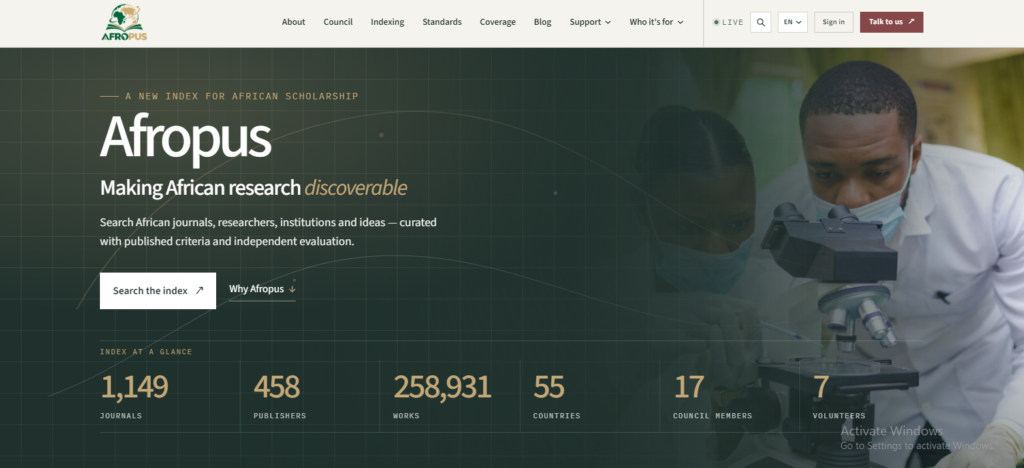
Afropus contributes to this effort by focusing on the discovery of African scholarship and helping readers find research, journals, researchers, and institutions more easily.
Making African Scholarship Easier to Discover
African research can be spread across numerous journals, institutional websites, and digital repositories. Finding relevant work may require searching several sources individually.
Afropus provides a dedicated discovery environment for African scholarship, helping readers explore:
- African academic journals and their contributions.
- Researchers and their scholarly work.
- Institutions involved in research and knowledge production.
- Research topics and ideas across different fields.
By bringing these elements into a research-focused environment, Afropus helps make African scholarship easier to explore.
Bringing Greater Visibility to African Researchers and Journals
Research visibility depends partly on whether readers can identify the people and publications behind scholarly contributions.
Afropus focuses on making African researchers, academic journals, and institutions more discoverable. This gives readers another way to explore scholarship from across the continent and identify work relevant to their interests.
For researchers and publishers, greater discoverability can create additional opportunities for their contributions to reach interested audiences, although it does not guarantee citations or recognition.
Connecting African Research With Wider Academic Audiences
African scholarship can offer valuable insights into challenges and opportunities that matter both locally and globally. However, readers cannot engage with research they cannot easily find.
By helping people discover African journals, researchers, institutions, and ideas, Afropus supports access to scholarship beyond familiar academic networks.
This can help students identify relevant literature, researchers explore related studies, and readers discover contributions from institutions they may not have encountered otherwise.
Contributing to a More Inclusive Research Ecosystem
Improving African research visibility is a shared responsibility. Universities, funders, publishers, researchers, and discovery platforms all contribute to how scholarship is produced, shared, and accessed.
Afropus forms part of this wider effort by focusing on the discoverability of African scholarship. It complements existing academic databases, institutional repositories, and publishing systems rather than replacing them.
Ultimately, making African research easier to discover is a practical step towards a more inclusive research environment, where scholarly contributions from across the continent have greater opportunities to be found, explored, and considered.
FAQs
Why Is African Research Underrepresented Globally?
African research can face several barriers, including limited funding, publishing costs, language differences, unequal access to academic networks, and limited representation in some major research indexes. Digital discoverability also matters because published studies may remain difficult to find even when they are available online.
Does Africa Produce Enough Academic Research?
African researchers contribute to a wide range of fields, including medicine, agriculture, technology, education, and environmental science. However, research output and resources vary across countries, institutions, and disciplines. The challenge is not simply how much research is produced, but also whether that research can be published, accessed, and discovered by relevant audiences.
Why Is Research Indexing Important for African Scholars?
Research indexing helps readers find academic journals, publications, authors, and institutions. It can improve the discoverability of scholarly work and make it easier for researchers to identify relevant studies. For African scholars, accessible indexing and discovery systems provide additional opportunities for their contributions to reach wider academic audiences.
How Can African Researchers Make Their Work More Visible?
Researchers can improve visibility by maintaining accurate publication records, using institutional repositories, creating and updating researcher profiles, sharing findings through academic networks, and ensuring their publications have complete metadata. Publishing through credible journals and making work accessible through appropriate research discovery platforms can also help.
What Is Afropus, and How Does It Support African Research Visibility?
Afropus is a research indexing and discovery platform focused on African scholarship. It helps readers discover African journals, researchers, institutions, and research, making scholarly contributions easier to explore. By focusing on African research, Afropus contributes to wider efforts to improve the visibility and accessibility of scholarship from across the continent.
Final Thoughts on Why Africa Has Remained Underrepresented in Research Works
Africa’s research underrepresentation is not only about producing more academic work.
It is also about ensuring that existing scholarship can be found, accessed, and considered by the people who need it.
Addressing the challenge requires stronger research infrastructure, sustainable publishing opportunities, better digital discoverability, and closer collaboration across academic communities. Researchers, institutions, publishers, and discovery platforms all have a role to play.
Afropus contributes to this effort by helping make African scholarship more discoverable. As more readers gain access to research from across the continent, African scholars have greater opportunities to share their findings and contribute to global academic conversations.
Explore Afropus and make African research easier to discover, connect, and engage with.


Leave a comment