Discover how to find journal indexes by country and explore how Afropus helps researchers discover African journals and scholarly works across the continent.
TL;DR
- A research index by country helps researchers discover academic journals and scholarly publications relevant to a specific country or region.
- Finding African journals can be challenging because research is spread across different platforms, institutions, and languages.
- Afropus focuses on improving the discoverability of African scholarship, with a geographic framework covering 55 African jurisdictions across five regions.
- Researchers can use Afropus to explore indexed journals, scholarly articles, African research institutions, and multilingual scholarship.
- Afropus is a growing resource currently in its curated pilot phase. Researchers should check its available listings and complement their searches with other academic databases when necessary.
Finding the right academic journal or research publication can be challenging, especially when your work focuses on a specific country or region.
Broad academic databases are useful, but researchers may also need resources that help them discover locally published journals and studies addressing the realities of particular communities.
This is important for Africa-centric research. Studies on public health, education, agriculture, governance, and economic development often draw on evidence from individual African countries. Discovering this research can provide valuable context and help researchers build a stronger understanding of their subjects.
Afropus supports this process by building an index focused on African scholarship and publishing ecosystems. Its geographic framework covers 55 African jurisdictions, providing a foundation for discovering relevant journals and scholarly works as coverage grows.
You May Also Like: Best 3 African Research Journal Indexes for Discovering African Scholarship
Table of Contents
What Is a Research Index by Country?
A research index by country is a resource that helps users discover academic journals and scholarly publications associated with a particular country.
Depending on the platform, it may organise research by geographic location, subject area, journal, author, or institution.
For researchers, country-specific discovery can be useful when studying local issues, comparing findings across regions, or identifying journals that publish work relevant to a particular national context.
For example, a researcher investigating maternal healthcare in Nigeria may want to find studies published by Nigerian researchers, alongside relevant evidence from other African countries. Similarly, someone studying agricultural development in Kenya may benefit from discovering journals that publish research on local farming systems, climate conditions, and agricultural policies.
It is also important to distinguish between different types of research resources:
- Research indexes: Organise scholarly publications to support discovery, often using structured metadata and links between works.
- Journal directories: Provide information about academic journals, which may include their scope, publishers, and editorial details.
- Academic search engines: Search across a range of scholarly sources to help users locate articles and other research materials.
These resources can complement one another. The right choice depends on your research question, the geographic coverage you need, and the type of material you want to find.
Why Finding African Journals by Country Can Be Challenging
Finding academic journals and research publications from specific African countries is not always straightforward.
Relevant studies may be spread across university repositories, local publishing platforms, disciplinary databases, and international indexes. Researchers often need to search several resources to build a useful picture of the available literature.
Some common challenges include:
- Limited discoverability: Research published by local institutions and regional journals may be harder to find through general searches.
- Fragmented publishing ecosystems: Journals and scholarly works are distributed across different platforms, making country-specific searches more time-consuming.
- Language diversity: African scholarship is published in multiple languages. Researchers may miss relevant work if their search is limited to one language.
- Inconsistent metadata: Differences in article descriptions, author information, identifiers, and citation records can make publications harder to locate and evaluate.
- Difficulty assessing journal quality: Researchers must distinguish credible, peer-reviewed journals from outlets with unclear editorial practices or inadequate quality controls.
These challenges do not mean that African research is unavailable. Rather, they highlight the need for discovery resources that recognise the continent’s diverse publishing ecosystems and make relevant scholarship easier to find.
Recommended For You: Looking for a Journal Management System? Try Alkademy Press
How Afropus Can Help Scholars Discover African Journals by Country
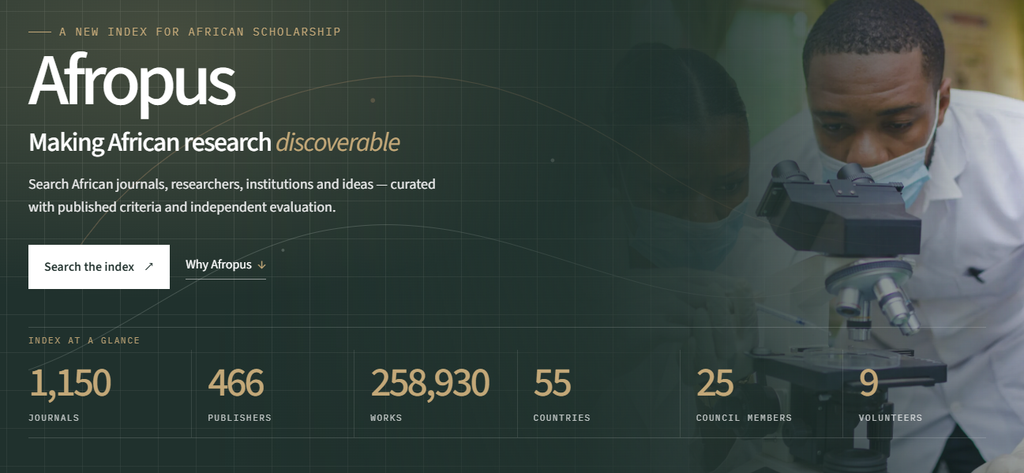
Afropus is building a research index focused on African scholarship, with an emphasis on improving the visibility of journals and scholarly works connected to African publishing ecosystems.
The index coverage spans 55 African jurisdictions across five regions.
This gives researchers a structured starting point for exploring African research and identifying publications relevant to particular countries and research questions.
Afropus focuses on peer-reviewed scholarly journals that meet its published quality and integrity requirements. Its current version indexes scholarly works associated with indexed journals, supporting discovery through available abstracts, identifiers, author information, and citations.
The platform also recognises the importance of multilingual scholarship. African, indigenous, local, and endangered languages are part of its inclusion priorities, provided the relevant metadata requirements are met. This helps support a broader scholarly record that reflects the diversity of research produced across the continent.
Researchers can also explore profiles of African universities and research institutions, connecting institutional information with works already indexed on Afropus.
Afropus is currently building coverage through a curated pilot of 25 to 50 journals before opening applications more broadly. Its geographic scope represents the countries and jurisdictions it aims to cover, not a guarantee that journals and articles from all of them are already indexed.
For researchers looking for country-specific African scholarship, Afropus is a useful starting point. Its current search results and journal listings can help identify available material, while other academic databases and repositories can supplement searches where broader coverage is needed.
Explore Research Coverage Across 55 African Countries and Jurisdictions
Afropus organises its geographic coverage into five African regions: North, West, Central, East, and Southern Africa. This framework provides a way to explore the continent’s diverse research and publishing ecosystems.
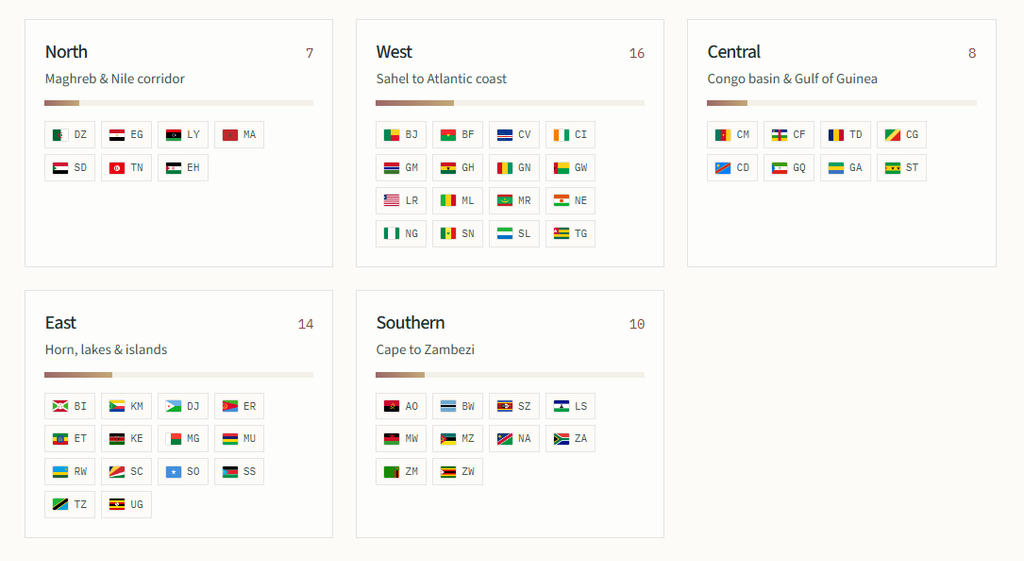
Here are the full list of countries and jurisdictions Afropus currently covers:
North Africa
Countries and jurisdictions: Algeria, Egypt, Libya, Morocco, Sudan, Tunisia, and Western Sahara.
North Africa has diverse research interests spanning public health, history, agriculture, environmental studies, economics, and social sciences. Exploring scholarship by country can help researchers identify studies shaped by local policies, institutions, and social conditions.
West Africa
Countries: Benin, Burkina Faso, Cabo Verde, Côte d’Ivoire, The Gambia, Ghana, Guinea, Guinea-Bissau, Liberia, Mali, Mauritania, Niger, Nigeria, Senegal, Sierra Leone, and Togo.
Country-specific discovery can support research into education, public health, agriculture, governance, economic development, and language. It can also help researchers compare findings across neighbouring countries while accounting for their distinct contexts.
Central Africa
Countries: Cameroon, Central African Republic, Chad, Republic of the Congo, Democratic Republic of the Congo, Equatorial Guinea, Gabon, and São Tomé and Príncipe.
Research across Central Africa addresses subjects such as biodiversity, conservation, public health, natural resources, and social development. Discovering publications by country can help researchers locate locally relevant evidence and better understand regional differences.
East Africa
Countries: Burundi, Comoros, Djibouti, Eritrea, Ethiopia, Kenya, Madagascar, Mauritius, Rwanda, Seychelles, Somalia, South Sudan, Tanzania, and Uganda.
East African scholarship covers a broad range of subjects, including climate resilience, agriculture, healthcare, education, migration, and economic development. Country-specific searches can help researchers find evidence relevant to national priorities as well as studies addressing shared regional challenges.
Southern Africa
Countries: Angola, Botswana, Eswatini, Lesotho, Malawi, Mozambique, Namibia, South Africa, Zambia, and Zimbabwe.
Researchers exploring Southern Africa may investigate mining, public health, environmental management, education, agriculture, and social policy. Discovering journals and scholarly works by country can help them identify research that reflects local conditions and supports comparisons across the region.
Important note: Afropus’s 55-jurisdiction framework describes its intended geographic scope. Actual journal and article availability varies as the index develops. Researchers should check the platform’s current listings to confirm which publications are available.
What Afropus Brings to the Table
Finding relevant African scholarship involves more than searching for a journal in a particular country. Researchers also need ways to discover published studies, explore research institutions, and assess whether a journal aligns with their work.
Afropus is designed to support this process by improving the discoverability of African journals and scholarly works. Here are some ways the index can help and some of what makes it stand out.
Recommended For You: Scopus Vs Afropus: Which Journal Indexing Platform is Right for Me?
Discover Journals Relevant to African Countries
Afropus uses a geographic framework covering 55 African jurisdictions across five regions. This provides a foundation for discovering journals connected to African publishing ecosystems and finding research relevant to particular countries.
Researchers can explore the journals currently listed in the index to identify potential sources for country-specific studies. Since coverage is still developing, it is important to check the available listings rather than assume every country or discipline is fully represented.
Find Scholarly Articles for Literature Reviews
A strong literature review requires relevant evidence from a range of credible sources. Afropus indexes scholarly works associated with its indexed journals, supporting discovery through available abstracts, author details, identifiers, and citations.
These records can help researchers identify relevant publications, follow citations to related work, and build a more informed understanding of a research topic. For comprehensive reviews, Afropus can be used alongside other academic databases and repositories.
Discover African Universities and Research Institutions
Research institutions are important sources of locally relevant knowledge. Afropus provides a directory of African universities and research institutions, with profiles that connect institutional identities to works already indexed on the platform.
This can help researchers explore scholarship associated with particular institutions and identify potential sources for further investigation.
Explore Multilingual and Indigenous Scholarship
African scholarship spans many languages and research traditions. Limiting searches to widely used international academic languages can make it harder to discover work that reflects local knowledge and experiences.
Afropus allows African, indigenous, local, and endangered languages as part of its inclusion priorities. This approach supports a broader scholarly record in which language diversity is recognised as part of Africa’s research landscape.
Evaluate Journal Suitability and Quality
Discovering a journal is not the same as confirming that it is the right choice for your research. When evaluating a journal, researchers should review its editorial policies and consider established guidance on publication ethics and peer-review standards.
Afropus applies published quality and integrity requirements to journal inclusion. Researchers should still assess whether a particular journal suits their discipline, research question, and intended audience.
You May Be Interested In: Learn How Afropus Indexes Journals
Is Afropus the Right Research Index for Africa-Centric Work?
Afropus is particularly relevant to researchers seeking a resource focused on African scholarship. Its geographic framework, journal indexing approach, institutional directory, and commitment to multilingual research address several important aspects of African research discovery.
It can be useful when you want to:
- Discover journals associated with African publishing ecosystems.
- Find scholarly works relevant to African countries and research questions.
- Explore research connected to African universities and institutions.
- Improve the geographic and linguistic breadth of your literature searches.
However, Afropus is still developing its coverage through a curated pilot of 25 to 50 journals before opening applications more broadly. Its geographic scope should not be confused with complete journal coverage across all 55 jurisdictions.
Researchers should review the journals and works currently available and supplement their searches with other relevant resources where necessary.
FAQs
What Is a Research Index by Country?
A research index by country helps researchers discover academic journals and scholarly publications associated with a specific country or region. It can support literature reviews, country-specific studies, and the discovery of locally relevant research.
How Can I Find Academic Journals Published in My Country?
Start by searching academic libraries, university repositories, national research resources, and scholarly indexes. Use your country’s name alongside your research topic, then assess each journal’s scope, peer-review practices, and editorial standards. For African scholarship, Afropus provides another resource to explore.
Does Afropus Cover All African Countries?
Afropus’s geographic framework covers 55 African jurisdictions across five regions. However, this describes its intended coverage, not a guarantee that journals and articles from every jurisdiction are already indexed. Check the current listings to see what is available.
Is Afropus Suitable for Finding African Journals for Publication?
Afropus can help researchers discover journals associated with African publishing ecosystems. Before submitting a manuscript, review the journal’s subject scope, author guidelines, peer-review process, and editorial policies to determine whether it is suitable for your work.
Can I Use Afropus Alongside Scopus and Other Research Databases?
Yes. Afropus can complement Scopus and other academic databases by providing another resource focused on African scholarship. Using multiple appropriate sources can help you discover additional research and build a more comprehensive literature review.
Does Afropus Include Research Published in African and Indigenous Languages?
Afropus prioritises multilingual scholarship, including work in African, indigenous, local, and endangered languages. Language alone is not grounds for excluding a journal when the relevant metadata requirements are met.
Final Thoughts On Finding Research Index By Country
Finding relevant research by country can help you build stronger literature reviews, understand local contexts, and discover scholarship that might otherwise be overlooked.
The key is to use resources that match your geographic and disciplinary needs while checking the quality and coverage of the material you find.
For Africa-centric research, Afropus offers a growing index focused on African journals and scholarly works, alongside a directory of African universities and research institutions. Although its coverage is still developing, it provides a useful starting point for exploring the continent’s diverse research landscape.


Leave a comment