
Discover the best African research journal indexes, compare Afropus, AJOL and African Index Medicus, and find the right platform for your research.
Table of Contents
Quick Answer: What Are the Best 3 African Research Journal Indexes?
The three African research journal indexes to know are Afropus, African Journals Online (AJOL), and African Index Medicus (AIM). Afropus is the strongest starting point for discovering African scholarship across journals, researchers, institutions and research topics. AJOL provides access to African-published academic journals, while AIM specialises in African health and biomedical literature.
Which African research index should you use?
| Platform | Best suited to | Important consideration |
| Afropus | Following the development of an Africa-focused, multidisciplinary research discovery index | Its current public website describes a developing initiative and says live index counts will arrive when the index opens. Verify launch status and actual search availability before relying on it. |
| African Journals Online (AJOL) | Discovering African-published academic journals and their available articles | Journal inclusion does not establish indexing in every other bibliographic database or guarantee access to every full-text article. |
| African Index Medicus (AIM) | Finding health and biomedical literature published in or related to Africa | Its subject focus makes it especially relevant to medical and public health research, not a replacement for multidisciplinary searching. |
Choosing the right African research index depends on your subject, the type of scholarly material you need, and your research goals. Whether you want to discover relevant articles, access full-text publications, evaluate a journal, or verify its indexing status, each platform serves a different purpose.
This guide compares Afropus, African Journals Online (AJOL), and African Index Medicus (AIM), examining their key features, intended uses, and limitations to help you choose the right resources for your literature review, dissertation, policy report, or journal-submission decision.
Afropus: An Emerging Africa-Focused Research Discovery Index
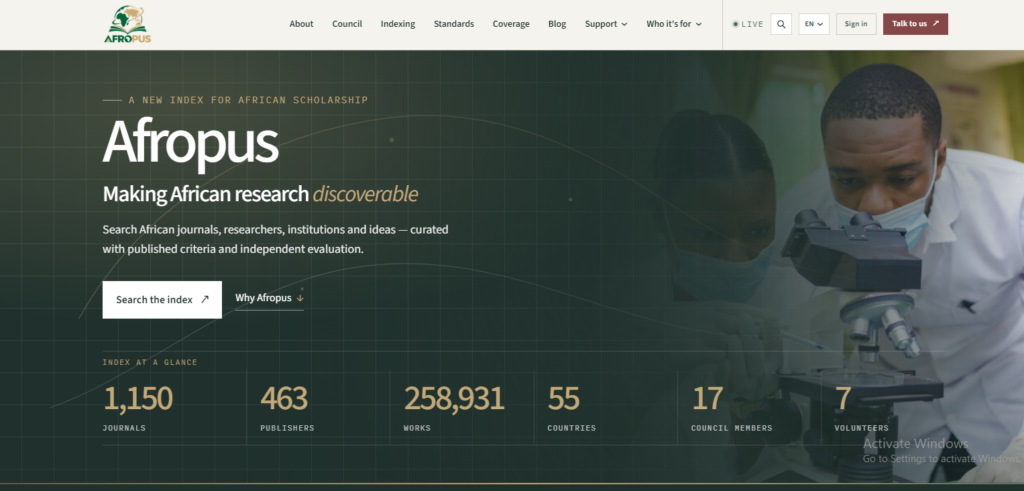
Best suited to: Researchers, students, librarians and institutions interested in a connected discovery approach to African scholarship.
Website: Afropus
Afropus is developing an Africa-focused research discovery initiative intended to make scholarly work easier to find and connect. Its scope extends beyond journal titles to research papers, researchers, institutions, topics and academic disciplines.
The index is built around a clear goal: making African scholarship easier to discover and explore. Its network spans 1,150 journals, 463 publishers, 258,931 scholarly works and 55 countries, supported by 17 council members and 7 volunteers.
What is Afropus designed to do?
Afropus is organised around five research discovery categories:
- Research papers and scholarly works.
- Academic journals.
- Researchers and their contributions.
- Universities and research institutions.
- Topics and academic disciplines.
The index’s coverage spans five African regions and 55 jurisdictions, with the stated goal of improving visibility across African publishing ecosystems.
Its four stated evaluation pillars are published criteria, integrity gates, transparency and appeals. These provide a framework for understanding its intended approach to evaluation.
Who should consider Afropus?
Afropus is worth monitoring if you:
- Want a discovery platform built specifically around African scholarship.
- Need a connected view of research, researchers, institutions and subjects.
- Work in scholarly publishing, research communication or academic library services.
- Want to follow developments in African research discovery infrastructure.
African Journals Online (AJOL): Best for Discovering African-Published Journals
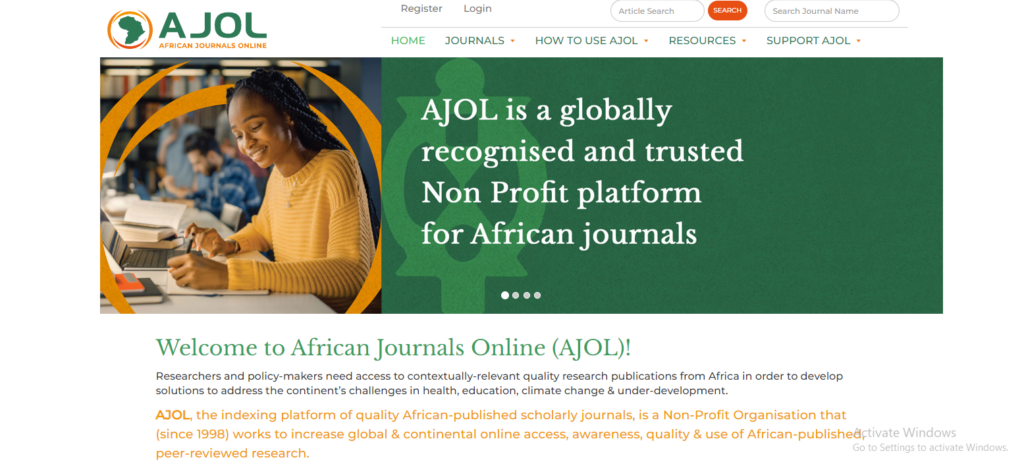
Best suited to: Students, academics, librarians and researchers looking for journals and articles published by African scholarly publishers.
Website: African Journals Online
African Journals Online is a not-for-profit scholarly publishing platform that has worked since 1998 to increase the visibility, accessibility and use of African-published research.
Its collection spans multiple disciplines, including agriculture, health, education, engineering, economics, the humanities and social sciences. Researchers can browse journals by subject, country, title and other available categories.
AJOL is particularly useful when you want to discover publications associated with African research communities or locate an article through the journal in which it appeared.
What makes AJOL useful?
Journal discovery across disciplines
AJOL organises its partner journals into subject and country directories. These are practical starting points when you know the discipline or geographic focus of your research but have not yet identified the relevant journals.
Access to article records and available full text
The platform provides a bibliographic database and links to article content. However, the availability of full text varies. A record may help you identify a publication even when reading the complete article requires visiting the publisher or meeting an access condition.
Journal publishing information
AJOL provides information about its Journal Publishing Practices and Standards (JPPS) framework, managed with INASP. The framework assesses journal publishing practices and assigns ratings to help readers and editors understand the standards a journal has met.
AJOL explains that the framework is used to assess new journals and reassess existing partner journals. Its rating categories include new, inactive, one-star, two-star, three-star, no-star and pending classifications. These categories are specific to the JPPS system, not universal journal-quality ratings.
Read the JPPS framework documentation before interpreting a rating.
How to use AJOL effectively
- Begin with a subject, country or known journal title.
- Search using the main concept in your research question.
- Try alternative terminology, synonyms and spelling variants.
- Inspect the article title, authors, publication date and available identifiers.
- Follow the article link to the publisher and check whether the full text is available.
- Review the journal’s publishing information if you are evaluating it for submission.
For example, a student investigating agricultural extension in Nigeria could start with AJOL’s subject and country directories, search for relevant articles, and then check each publication’s methodology and references.
This is a recommended workflow, not a claim that a particular search has been performed or that a specific number of relevant results will be returned.
What AJOL does not establish by itself
Finding a journal on AJOL does not automatically establish that it is indexed in Scopus, Web of Science, MEDLINE or another database required by a particular institution.
Likewise, a journal’s presence on a platform does not remove the need to assess its editorial practices, peer-review process, publication ethics and suitability for your research.
African Index Medicus (AIM): Best for African Health and Biomedical Literature
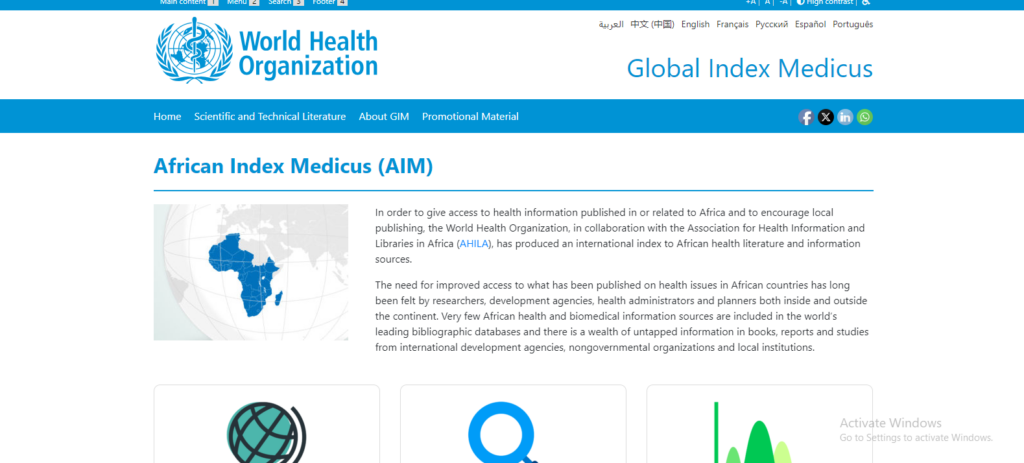
Best suited to: Medical researchers, public health professionals, postgraduate students, health librarians and policy researchers.
Website: African Index Medicus
African Index Medicus is an international index of health information published in or related to Africa. Its development involves the World Health Organization’s Regional Office for Africa and the Association for Health Information and Libraries in Africa.
WHO describes the initiative as a response to the need for greater visibility of African health publications, including material that may be difficult to locate through major international bibliographic databases alone.
Its specialised scope makes AIM a valuable resource for health-related literature reviews.
What can researchers find through AIM?
AIM provides access to a database of health and biomedical literature, journal information and records relating to relevant research. Its resources include article records and information about theses and dissertations in medicine and public health.
The database also offers search tools and subject terminology resources, including Medical Subject Headings (MeSH). Subject headings can help researchers find material when authors use different words to describe similar concepts.
For example, a researcher studying maternal health in West Africa could search AIM for relevant studies, examine the bibliographic details and follow available links to full text or other sources.
The researcher should also search broader biomedical databases where appropriate, because no single resource can be assumed to contain every relevant study.
Why AIM matters
Local health research can be important for understanding disease patterns, healthcare delivery, health systems and interventions in specific populations. When relevant literature is difficult to discover, researchers risk overlooking existing evidence or duplicating work.
AIM’s explicit focus on health information published in or related to Africa helps address this discovery challenge.
It also provides a route for publishers to request consideration for journal inclusion. Inclusion should be interpreted in accordance with AIM’s own policies and scope.
What are AIM’s limitations?
AIM is primarily a health information resource. It is not the appropriate sole database for a multidisciplinary review of African literature, education, engineering, economics or other unrelated fields.
It is also important to distinguish bibliographic discovery from evidence appraisal. Finding a health study in AIM does not establish that its methods are sound, its conclusions are reliable or its findings apply to every population.
Researchers should assess study design, sample selection, limitations, conflicts of interest and the relevance of the results to their research question.
Comparing Afropus, AJOL and African Index Medicus
The most useful comparison begins with what each platform actually does and what evidence is available to support its current capabilities.
| Comparison criterion | Afropus | AJOL | African Index Medicus |
| Primary purpose | Developing Africa-focused research discovery initiative | Discovery of African-published journals and articles | Discovery of health information published in or related to Africa |
| Subject scope | Multidisciplinary | Multidisciplinary | Health and biomedical literature |
| Geographic emphasis | African regions and jurisdictions | Journals published across African countries | Health literature published in or related to Africa |
| Journal browsing | Connected discovery framework | Documented journal directories | Health journal information and listings |
| Researcher and institution discovery | Organised around journals, articles, institutions and country | Primarily organised around journals and articles | Primarily focused on health information |
| Journal publishing assessment | Four evaluation pillars; implementation should be checked against published evidence | JPPS publishing-practices framework | Selection and integration processes for health information |
| Full-text availability | Must be confirmed against actual records and links | Depends on the journal and article | Full text where available, with links to other sources |
| Best use | Exploring African scholarship and its connections | Finding African-published scholarly content | Searching African health and biomedical literature |
This table compares documented purposes and stated design. It is not an independent performance audit, and it does not rank record completeness, search relevance, update speed or scholarly quality.
How to Choose the Right African Research Index
Your choice should follow your research task rather than the popularity of a platform.
For a multidisciplinary literature review
Start with AJOL to identify African-published journals and articles relevant to your subject. Expand your search to appropriate subject databases, institutional repositories and other scholarly indexes.
Evaluate Afropus as an additional resource once its live index is available and its coverage can be tested.
For medical and public health research
Search AIM alongside relevant biomedical databases. Use alternative terms and subject headings where available, then verify each result against the original publication.
For systematic reviews, document all databases searched, search dates, complete search strings and screening criteria.
For finding a particular journal
Search the platform’s journal directory and the publisher’s official website. Verify the journal’s full title, ISSN, publisher, editorial board, current publication activity and manuscript-submission information.
If your institution requires a particular database, confirm the journal’s current status directly through that database rather than relying on a general directory listing.
For assessing journal credibility
Review the journal’s peer-review policy, editorial governance, publication ethics, fees, correction and retraction policies, and transparency about ownership.
Look for evidence that these practices are implemented, not merely promised. Confirm that the journal’s stated indexing can be independently verified.
For obtaining full text
Check whether the article record links to a publisher version, an authorised repository copy or another legitimate full-text source. A bibliographic record and a downloadable article are not the same thing.
If you cannot access a paper, search its exact title, DOI and author names through the publisher, institutional repository or library services.
Practical Test to Evaluate an African Research Index
The following step-by-step method helps researchers, librarians and editorial teams evaluate these platforms consistently and make informed, evidence-based decisions.
Step 1: Define a balanced set of research questions
Select five to ten queries covering different topics, countries and search styles. Include:
- A broad multidisciplinary topic.
- A country-specific research question.
- A health or biomedical topic.
- A phrase taken from a known paper title.
- A query using an alternative spelling or synonym.
Use the same query where the platforms support comparable searches. If a platform is not designed for a particular discipline, mark the comparison as not applicable rather than treating the absence of a feature as a failed search.
Step 2: Record the search conditions
For each platform, record the search date, exact query, available filters and result count. Note whether the count refers to records, articles, journals or another unit.
If a platform is unavailable or not yet open for public searching, record that fact. Do not infer search quality from its promotional pages.
Step 3: Check the relevance of the results
Inspect a consistent sample of returned records. Record whether each result directly answers the research question, is only tangentially related or is irrelevant.
A simple precision measure is:
Precision = relevant results ÷ all results assessed
For example, if 20 records are assessed and 15 are relevant, the observed precision is 75%. This is an illustrative calculation, not a measured result for any of the three platforms.
Precision measures relevance among retrieved records; it does not measure how much of the total relevant literature a platform contains. Assessing recall requires a defensible reference set of known relevant studies.
Step 4: Verify bibliographic accuracy
For each sampled record, compare the title, authors, year, journal and DOI, where available, with the publisher’s version or another authoritative source.
Record missing fields, incorrect links, duplicate records and discrepancies. A search result can be relevant while still containing incomplete or inaccurate metadata.
Step 5: Check access and currency
Record whether the result provides a working full-text link, a publisher page, an abstract or citation details only.
Check publication dates and the latest available issue where relevant. A journal being listed does not establish that its newest content has been included.
Step 6: Publish the methodology and limitations
Report the number of queries, search dates, sample size, relevance criteria and verification method. Explain which features could not be tested.
Do not claim that one platform is the most comprehensive or accurate unless the evidence supports that conclusion within the stated test scope.
Common Mistakes When Using African Research Indexes
- Mistake 1: Assuming one index contains everything. Search complementary resources because coverage varies by subject, journal, country and publication type.
- Mistake 2: Confusing discoverability with credibility. A listing helps locate a record; it does not automatically validate the study or the journal.
- Mistake 3: Treating journal inclusion as universal indexing. Check each database separately if a university, funder or employer specifies where a journal must be indexed.
- Mistake 4: Assuming every result has free full text. A citation may be accessible when the complete article is not.
- Mistake 5: Ignoring metadata and terminology. Differences in spelling, author names, transliteration, subject labels and incomplete records can affect discovery.
- Mistake 6: Citing a database record without checking the original source. Verify the publication details and use the authoritative article version where possible.
Why Start With Afropus?
Afropus is a promising starting point for discovering African scholarship across disciplines. Its Africa-focused approach aims to connect research papers, journals, researchers, institutions and academic topics in one discovery framework.
Three features define its approach:
- Africa-first focus: Designed to improve the visibility of research across five African regions and 55 jurisdictions.
- Connected research discovery: Aims to help users explore scholarship through publications, researchers, institutions and topics.
- Transparent evaluation: Identifies published criteria, integrity gates, transparency and appeals as core evaluation principles.
These features position Afropus as one of the best indexes to consider for broad African research discovery.
FAQs
What is the best African research journal index?
There is no single best index for every research task. AJOL is a useful starting point for African-published journals and articles, while AIM is suited to health and biomedical literature related to Africa. Afropus is developing a broader African research discovery initiative, with over 1,100 journals across 55 countries.
What is the difference between Afropus and AJOL?
Afropus uses a connected discovery model intended to link scholarly works, journals, researchers, institutions and topics. AJOL provides an established platform for discovering African-published journals and their available articles.
Does being listed in a research index mean a journal is reputable?
Not automatically. Check the index’s inclusion policy and the journal’s actual publishing practices. Verify any required indexing status directly with the specified bibliographic database, and assess peer review, editorial governance, publication ethics and fees.
Are articles on AJOL freely available?
Not every article should be assumed to have free full-text access. Check the individual record and publisher link for access conditions. Distinguish open-access articles from citations that lead to subscription-based or otherwise restricted content.
How can I verify that a journal is indexed in a particular database?
Search the database’s official source using the journal’s exact title and ISSN. Check whether the listing is current and whether the relevant publication years are covered. If the journal’s status affects eligibility for a degree, grant or promotion, retain a dated record of the verification.
Final Thoughts on the Best African Research Journal Index
African research is diverse, and finding the right literature often means looking beyond a single journal or database. Afropus, AJOL and African Index Medicus each contribute to that discovery process in different ways.
For a broad, Africa-focused starting point, Afropus stands out for its stated aim of connecting journals, scholarly works, researchers, institutions and research topics. AJOL provides an established route to African-published journals, while AIM offers a specialised resource for health and biomedical literature.
The most effective research workflow begins with the platform that best fits your question and expands to other sources when needed.
Ready to explore African scholarship? Visit Afropus to discover the project, learn about its approach to African research visibility and sign up through the available registration option.


Leave a comment