Why Are Some Africans Opposing Afropus? Explore the debate around African research visibility, knowledge infrastructure, academic standards, and Afropus.
TL;DR
- Afropus is not about replacing global research indexes. It aims to create another pathway for discovering African scholarship, researchers, journals and institutions.
- African research is being produced at scale, but discoverability remains a challenge. Afropus is designed to make that research easier to find and connect.
- Questions about Afropus are legitimate. Researchers should scrutinise its methodology, data quality, inclusion criteria, transparency and standards.
- The debate should focus on evidence and standards, not identity. Afropus should neither be supported blindly because it is African nor dismissed because it is African-led.
- The bigger issue is African control and visibility in knowledge production. Afropus represents an opportunity to build stronger infrastructure for discovering and connecting African scholarship with audiences in Africa and around the world.
African scholarship is being produced by thousands of researchers, universities, journals, and research institutions across the continent.
The challenge is not simply producing knowledge. It is making that knowledge easier to discover, connect, and use.
That is the gap Afropus is trying to address.
Afropus is an African research discovery platform designed to help users find scholarship, researchers, journals, institutions, and research topics connected to Africa.
The idea is simple: African research should be easier to discover, both within Africa and by researchers around the world.
But that does not mean Afropus should be supported simply because it is African. Like any research platform, it should earn credibility through the quality of its data, the transparency of its methodology, the consistency of its inclusion criteria, and the usefulness of its results.
That leads to a more important question than simply asking who supports or opposes Afropus:
Can Afropus build research infrastructure that is genuinely useful, transparent and trusted?
Table of Contents
Afropus Is Challenging an Existing Knowledge Structure
For years, African scholarship has operated within a global research system where visibility and discoverability have often depended on institutions, publishers and indexing platforms based outside the continent.
That does not make existing international indexes the problem. They provide valuable services and remain important to researchers worldwide.
But it does raise a fair question: Who decides which African research gets seen, discovered and recognised?
Afropus is taking a different approach. Rather than relying entirely on existing systems to surface African scholarship, it is building a dedicated discovery platform focused on research, researchers, journals and institutions across the continent.
The ambition is straightforward: make African scholarship easier to discover and connect, both within Africa and beyond it.
That is a meaningful proposition. And whenever an established way of doing things is challenged, questions, criticism and debate are bound to follow.
The Historical Context Matters
To understand why African-led knowledge initiatives can sometimes attract resistance, it helps to look at the history of higher education in South Africa.
Apartheid did more than separate people by race. It also shaped who had access to education, which institutions received resources, and whose knowledge and perspectives were given prominence.
The University of Pretoria acknowledges its history within the apartheid era, when it was an exclusively white Afrikaner institution. Stellenbosch University has also acknowledged difficult parts of its history, including its links to apartheid-era policies and forced removals.
That history matters because universities are more than places where research is produced. They also influence which ideas are taught, which research gains visibility, and whose contributions become part of the wider academic record.
The Question of Institutional Legacy
This is where the discussion around Afropus becomes particularly interesting.
It would be unfair to suggest that academics at Stellenbosch or the University of Pretoria today generally hold an apartheid mindset. There is no evidence to support such a broad claim.
Both universities have undertaken significant transformation efforts, and South Africa’s higher education landscape has changed considerably over the years.
But institutional change does not happen overnight. The effects of historical structures can continue to shape debates around representation, academic culture, research priorities and who gets to influence the production and visibility of knowledge.
Recognising that history is not about assigning blame to individuals today. It is about understanding the context in which questions about African knowledge, representation and academic authority continue to be debated.
Representation Is Not the Same as Transformation
A university can become more demographically representative without every aspect of its knowledge infrastructure changing at the same pace.
Transformation can involve much more than who attends a university.
It can raise questions about:
- Which research receives visibility
- Which journals are considered influential
- Which institutions are treated as research centres
- Which scholars are widely cited
- Which databases researchers rely upon
- Which languages are represented in research discovery
- Which research evaluation systems influence academic careers
- Who controls the infrastructure through which scholarship is discovered
These are legitimate questions about the architecture of knowledge.
But they should be investigated with evidence rather than assumed to explain every disagreement.
Could Some Opposition Be About More Than Afropus?
This is where it is important to separate what we can establish from what we can only speculate about.
There is no basis for suggesting that Stellenbosch University, the University of Pretoria, or their academics as institutions are opposed to Afropus. Nor is it reasonable to describe an individual as holding an apartheid mindset without clear evidence of their views or actions.
But there is a broader question worth asking: Could resistance to African-led research infrastructure sometimes reflect older ideas about who gets to define academic authority and whose knowledge deserves greater visibility?
That question is worth discussing, particularly given the history of knowledge production and higher education on the continent.
For much of that history, African scholarship has often had to pass through institutions, publishers and systems outside Africa to gain wider recognition. Afropus challenges that model by creating a dedicated platform for discovering African research on a broader scale.
That does not mean rejecting global research indexes. It means creating another pathway through which African scholarship can be discovered, connected, and recognised.
Why Would Africans Oppose an African Research Index?
Not every African researcher who questions Afropus is necessarily opposed to the idea of African research infrastructure.
Some may simply want to understand how the platform works and whether it can meet the standards expected of a credible research indexing platform.
Those are fair questions. For example, researchers may want to know:
- How are journals evaluated?
- Who decides which publications qualify?
- How independent is the evaluation process?
- How are appeals handled?
- How will data quality be maintained?
- How will Afropus guard against bias?
- How will it complement existing indexes rather than simply duplicate them?
Afropus should welcome that scrutiny.
A credible research platform should be able to explain its methodology clearly, stand behind its standards, and remain open to constructive criticism.
Ultimately, the strongest case for Afropus is not that Africans should support it simply because it is African. It is that the platform should earn support by being useful, transparent, rigorous and credible, regardless of who built it.
What Afropus Is and Why You Should Get on Board
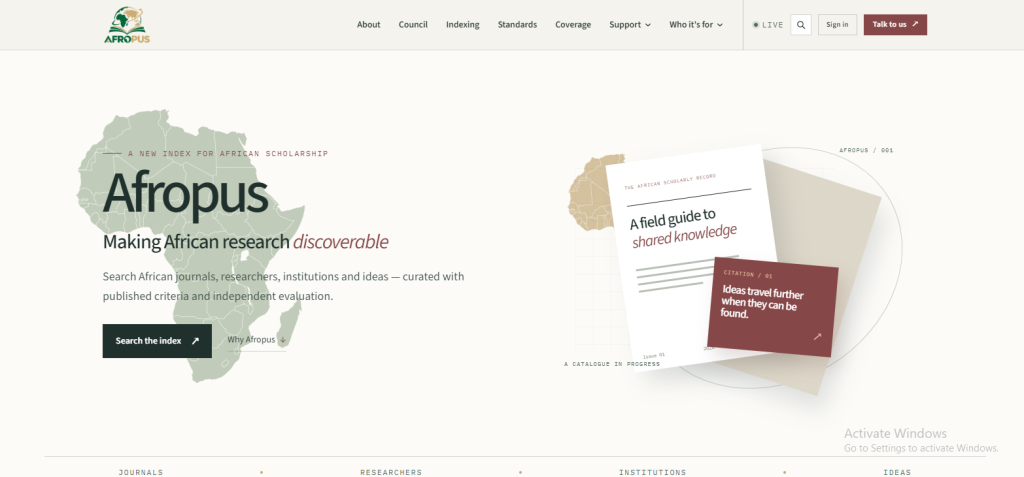
Afropus is an African research discovery platform built to make African scholarship easier to find, explore, and connect.
It brings together information about African journals, researchers, institutions and research topics to create a more connected discovery experience for scholarship produced across the continent.
But Afropus is not simply another academic directory. Its broader purpose is to strengthen the visibility and discoverability of African research.
For Researchers
Researchers can benefit from having their work and research profiles discoverable within a platform focused specifically on African scholarship.
Greater discoverability can help researchers connect with peers, institutions, and research communities working on related subjects.
For Journals
African journals can gain another channel through which their publications can be discovered.
This is particularly important for journals that publish valuable research but operate outside the most visible international publishing ecosystems.
For Universities and Research Institutions
Universities and research institutions can use Afropus to improve the discoverability of their researchers, publications, and areas of expertise.
It can also make it easier for researchers and institutions outside Africa to discover African research capacity.
For Students
Students need more than access to a handful of familiar databases.
They need ways to discover research produced by scholars working within their own countries, regions and continent.
Afropus can provide another starting point for finding African scholarship.
For Global Researchers
African research should not only be accessible to Africans.
Researchers anywhere in the world who are studying Africa, working with African institutions or researching topics relevant to the continent need better ways to discover African scholarship.
Afropus can serve as a bridge between African research and the wider global research community.
For Africa’s Knowledge Economy
Research is infrastructure.
The ability to discover, connect, and build upon existing knowledge affects education, innovation, policymaking, industry, and economic development.
The more discoverable African scholarship becomes, the easier it becomes to identify expertise, connect researchers and build collaborations across borders.
That is why getting behind African research infrastructure matters.
Why You Should Get on Board
Supporting Afropus does not mean abandoning Scopus, Web of Science or other established research databases.
It means recognising that African scholarship can benefit from research infrastructure built with Africa’s own research ecosystem in mind.
There is valuable research being produced across the continent, but much of it remains difficult to discover. Afropus offers another way to connect African researchers, journals, universities and ideas, while making this scholarship more visible to the world.
If you believe African research deserves greater visibility and stronger connections, Afropus is worth paying attention to.
But supporting Afropus should not mean supporting it blindly. Its methodology should be questioned, its standards examined, and its decisions held to account.
The goal is not to support Afropus simply because it is African. The goal is to build a platform that earns trust because it is useful, transparent, rigorous and accountable.
Afropus Is Bigger Than One Website
Afropus is more than another academic database. At its core, it is about making African knowledge easier to discover, connect, and share.
Across the continent, thousands of researchers, universities, journals, and research institutions are producing valuable work. But research can only have an impact if people can find it.
A researcher in Ghana should be able to discover relevant work from Kenya. A student in Nigeria should be able to find research from South Africa. A researcher in Senegal should be able to connect with scholarship from Uganda.
These connections can open the door to new ideas, collaborations, and opportunities.
The opportunity is straightforward: make African scholarship easier for people in Africa and around the world to discover.
The Debate Should Be About Standards, Not Identity
Afropus should be judged by the same standards as any serious research platform: the quality of its methodology, the transparency of its processes, the credibility of its data and the usefulness of its results.
If someone believes Afropus is unnecessary, they should be able to explain why. If they have concerns about its methodology, evaluation criteria or approach, those concerns should be raised and debated openly.
That is healthy academic debate.
What should not determine the conversation is where the platform was created. Being African-led should not make Afropus immune to criticism, but neither should it be a reason to dismiss the idea.
African ownership and intellectual openness can go hand in hand. In fact, they should. The stronger Afropus becomes, the more important it will be for the platform to welcome scrutiny, learn from constructive criticism, and earn trust through the quality of its work.
FAQs
What is Afropus?
Afropus is an African research discovery platform designed to make African scholarship easier to find, explore, and connect. It brings together information about researchers, journals, institutions and research areas, helping users discover knowledge produced across the continent.
Why does Africa need a research platform like Afropus?
Africa produces a significant amount of valuable research, but that work is not always easy to discover across countries, institutions, and disciplines. Afropus aims to improve that visibility by creating a dedicated discovery platform focused on African scholarship and the researchers producing it.
Is Afropus meant to replace Scopus or Web of Science?
No. Afropus does not need to replace established international research databases to be useful. It can provide an additional discovery layer focused on African scholarship, while researchers continue to use Scopus, Web of Science, and other platforms for their respective purposes.
Who can benefit from Afropus?
Researchers, students, universities, journals and research institutions can all benefit from greater visibility and easier discovery. It can also help researchers outside Africa find African scholarship, identify experts and discover institutions working on areas relevant to their research.
Should Afropus be criticised or questioned?
Absolutely. Being an African-led initiative does not mean Afropus should be above scrutiny. Its methodology, standards, inclusion criteria and decisions should be open to questions and constructive criticism. Ultimately, Afropus should earn trust through the quality, transparency and usefulness of the platform, not simply because it is African.
Final Thoughts on Why Some Africans are Opposing Afropus
The conversation around Afropus is really about a bigger question: How do we make African knowledge easier to find, connect, and share?
African researchers are doing important work across countless fields, and that work deserves to be visible both within Africa and around the world.
Afropus is one attempt to make that possible. It should be questioned and held to high standards, but it should also have the opportunity to demonstrate what African-led research infrastructure can achieve.
Ready to discover more African research and be part of a more connected research ecosystem?
Explore Afropus and discover African researchers, journals, institutions, and ideas.



Leave a comment